By Elena Hart · Wellbeing editor
TL;DR: A 2-minute calm-down ritual works best when it’s simple, repeatable, and attached to a moment that already exists in your day. What you need is a short pause, slow breathing with a longer exhale, and one quick sensory grounding check. Keep the steps the same each time and the habit builds on its own.
The Simplest 2-Minute Calm-Down Routine for Beginners
The simplest 2-minute calm-down routine requires only three things: a clear starting cue, one slow breath, and something to hold your attention for two minutes. Simpler is more likely to happen, especially when you’re already tense and the last thing you want is to recall a complicated technique.
A quick reset for a real busy day doesn’t need a quiet room, a cushion, or a meditation app. Your desk, a hallway, or thirty seconds before a call starts are all fine. No special setting needed.
To start, three steps are enough: sit or stand with both feet flat on the floor, take three slow breaths with each exhale longer than the inhale, and notice one thing you can feel in your body. You can build from there once it feels familiar.
The Breathing Pattern That Is Easiest to Remember Under Stress
The easiest breathing reset to recall under pressure follows one rule: make the exhale longer than the inhale. A common ratio is four counts in and six counts out. That single rule is enough to begin, with no timer or app needed.
Harvard Health notes that mini-relaxation exercises using slow breath-counting can be practiced almost anywhere, and suggests easing the pace if you begin to feel lightheaded. If anything feels off, slow down rather than push through.
Counting is optional. Some people picture the inhale slowly filling a glass and the exhale emptying it over a few extra seconds. The long exhale is what most brief calm-down methods share, and it needs no equipment, no timer, and no privacy.
How to Build a 2-Minute Calm-Down Ritual You’ll Actually Use: The Core 4-Step Sequence
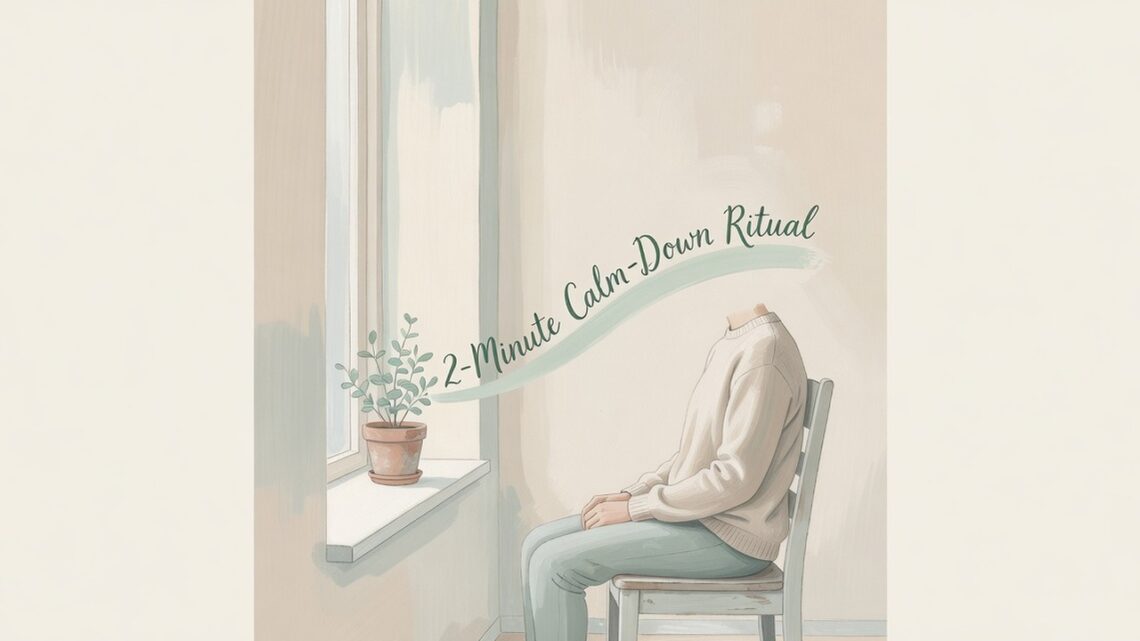
The best 2-minute calm-down sequence follows four steps: pause, breathe, ground, and re-enter. Each step takes roughly 30 seconds. Together they put a clear break between feeling reactive and coming back to steadier focus.
Step 1 – Pause: Silence or dim your phone, sit or stand upright, and let your shoulders drop. That small physical shift signals the start. Step 2 – Breathe: Take three to five slow cycles using the longer exhale ratio. Step 3 – Ground: Name one thing you can see, one you can feel, and one you can hear. That brief check pulls attention into the room you’re actually in, instead of leaving it stuck in whatever was running through your head. Step 4 – Re-enter: Say a short phrase to yourself, such as “reset, then begin,” before picking up the next task.
Set a 2-minute timer before you start. A clear end point makes the ritual feel contained and easy to enter. It’s the open-endedness that causes many calming practices to drift.
Try This: Sit upright right now, place both feet flat on the floor, and take one slow breath in for a count of four and out for a count of six. Notice the pressure of your feet on the floor and one sound in the room. That’s the whole thing in under thirty seconds. When you have two minutes, run all four steps at that same steady pace.
Why Posture Makes a Quick Reset More Effective
Sitting upright or standing with weight spread evenly across both feet sets a different starting point for the breath that follows. Hunching or collapsing inward tends to hold the body in a low-level tense state, and a little uprighting shifts that before breathing even begins.
Writers at Experience Life describe relaxed, upright posture and a steady gaze as things that make brief practices feel more real and worth repeating. The body holds a short memory for what calmer feels like, and sitting upright is one of the faster ways to prompt it.
Before the breathing step, let your jaw release and your shoulders drop. Both spots carry a lot of everyday tension. Releasing them takes a second and works as a clear signal that the ritual has started.
How to Build a 2-Minute Calm-Down Ritual You’ll Actually Use in Any Setting
A calm-down ritual that depends on a perfect quiet room gets skipped on the days you need it most.
A noisy office or shared space isn’t a barrier. The practice works with eyes open, and nothing around you needs to change. Sit upright, take a few quiet breaths, and run the grounding check silently. If the room is loud, shift sensory attention to physical sensations rather than sounds: the pressure of your feet on the floor, the temperature of the air, or the weight of your hands on the desk.
When the ritual keeps getting skipped, a small visual prompt often helps. A smooth stone or a particular mug on your desk can act as a quiet nudge that brings the habit back into view. For practical ideas on building everyday reminders into your routine, Mindful.org is worth browsing.
How Repetition Turns a Calm-Down Ritual Into an Automatic Habit
A habit becomes automatic through repetition in the same context, not through willpower. Doing the ritual at the same point each day means it gradually stops feeling like a decision and starts feeling like a natural shift between one thing and the next.
The most reliable approach is to attach the ritual to something you already do. Before you open your laptop in the morning, after lunch, or when you close your email at the end of the day are all good starting points. The four steps don’t change. Only the trigger shifts to fit your schedule.
Keeping the sequence identical every time matters as much as the timing. A routine that varies each day still requires thought. A fixed one removes that friction. Over a few weeks, the body begins to respond to the opening cue, the upright posture, the breath, the sensory check, as a familiar sign that a reset is on the way.
Quick Takeaways
- A 2-minute calm-down ritual works in ordinary settings: at your desk, standing up, or in a noisy shared room.
- The easiest breathing reset follows one rule: exhale longer than you inhale, such as four counts in and six out.
- The core sequence is four steps: pause, breathe, ground with a quick sensory check, then re-enter with a short phrase.
- Attaching the ritual to a predictable moment, like before a meeting or after lunch, makes it happen without extra effort.
- Keeping the steps identical each time is what turns a calm-down habit from effortful into automatic over a few weeks.
Frequently Asked Questions
- What is the simplest 2-minute calm-down routine for someone who has never tried mindfulness?
- Sit or stand tall with your feet flat on the floor. Take a few slow breaths, letting each out-breath last a little longer than the in-breath. Then notice one thing you can see or touch nearby. Those three steps are a complete starting point that works anywhere, no preparation needed. You can add the re-entry phrase and a 2-minute timer once the basic version feels comfortable.
- Which breathing pattern is easiest to remember when you are already stressed?
- The long exhale is the most forgiving pattern to recall under pressure because it has just one rule: breathe out for longer than you breathe in. A count of four in and six out is a common starting point, though any ratio that gives the exhale the longer share works equally well. You can skip counting entirely and just let the out-breath trail a few seconds longer than it would on its own.
- What grounding technique takes less than 30 seconds to complete?
- After one slow breath, notice something immediately visible, something you can feel on your skin or under your feet, and one sound in the room. Naming three concrete sensory details to yourself, even silently, is often enough to pull attention away from a racing mind and land it back where you actually are.
- How do I remember to use my calm-down ritual when the day gets hectic?
- Link the practice to a fixed moment in your day rather than trying to remember it when stress peaks. Predictable triggers work best: sitting down at your desk, finishing a meeting, or making a cup of tea. A small visual prompt placed somewhere you look often, a smooth stone, a post-it, or a particular cup, can serve as a nudge during the early weeks while the habit is forming.
- Can a 2-minute calm-down ritual work in a shared or noisy office?
- Yes. The practice works invisibly in a shared space with no change in how you appear to colleagues. Take a slow breath or two, settle your posture quietly, and check in with what you can feel in your body rather than fighting background noise. Physical sensations like the weight of your hands on the desk or the contact of your feet with the floor give attention a steady anchor in any environment.
Two minutes is a small window, and an imperfect reset still beats skipping it entirely. Give the sequence a few consistent tries and you may find it starts to feel less like an effort and more like a pause your day already had room for.
This article shares general wellbeing ideas for educational purposes only and is not medical advice. If you have a health concern, please speak with a qualified healthcare professional.