By Elena Hart · Wellbeing editor
TL;DR: A three-minute gratitude practice you can do anywhere involves pausing to recall a few small moments from your day, noting why each one felt helpful or welcome, and settling the reflection with one unhurried breath. No journal, special setting, or particular mood required.
A three-minute gratitude practice you can do anywhere is a short, flexible reflection that fits into ordinary life without requiring a perfect window of time or a tidy desk. You can do it on paper, in your head, or spoken quietly to yourself. It has roots in positive psychology and shows up in some cognitive approaches to building a more optimistic outlook, but you don’t need a therapist or a workbook to try it. Just a few moments of attention.
How the Three-Minute Gratitude Practice Works
The three-minute gratitude practice has three steps: name one to three moments from your day, add a brief reason each one mattered, and close with one slow breath. Set a loose three-minute timer, or just estimate the time without watching a clock.
- Notice: Let one to three small moments from your day surface naturally, without forcing or ranking them.
- Add meaning: For each moment, note briefly why it mattered or felt welcome to you.
- Close gently: Take one slow breath and let the reflection settle before returning to your day.
A helpful rhythm is to spend roughly one minute letting moments surface without forcing them, one minute noting a brief reason for each, and a final minute settling with a slow breath before you return to your day. You don’t need to write anything polished. A few words, even a single phrase, is enough.
The Three Good Things exercise, developed by the Greater Good in Action at UC Berkeley, follows this same pattern. It invites you to recall three positive events at the end of each day and briefly note why each happened. A three-minute version fits that structure well.
What to Write or Say: Specific Prompts and Examples
Specific, concrete details make each gratitude entry more grounding than broad statements. “My colleague replied quickly when I was stuck on a problem” is something you can actually picture; “I am grateful for the people in my life” is a pleasant enough thought but harder to hold. Specificity gives the moment weight, and you don’t need anything grand or dramatic to work with.
Rotating through a few simple prompts keeps the practice fresh. Try: “What supported me today?”, “What small comfort did I notice?”, and “What effort am I glad I made?” Each one pulls you toward a concrete memory rather than a general feeling. A simple connector that works well is “because”: name the moment, add “because”, and finish the thought in one sentence.
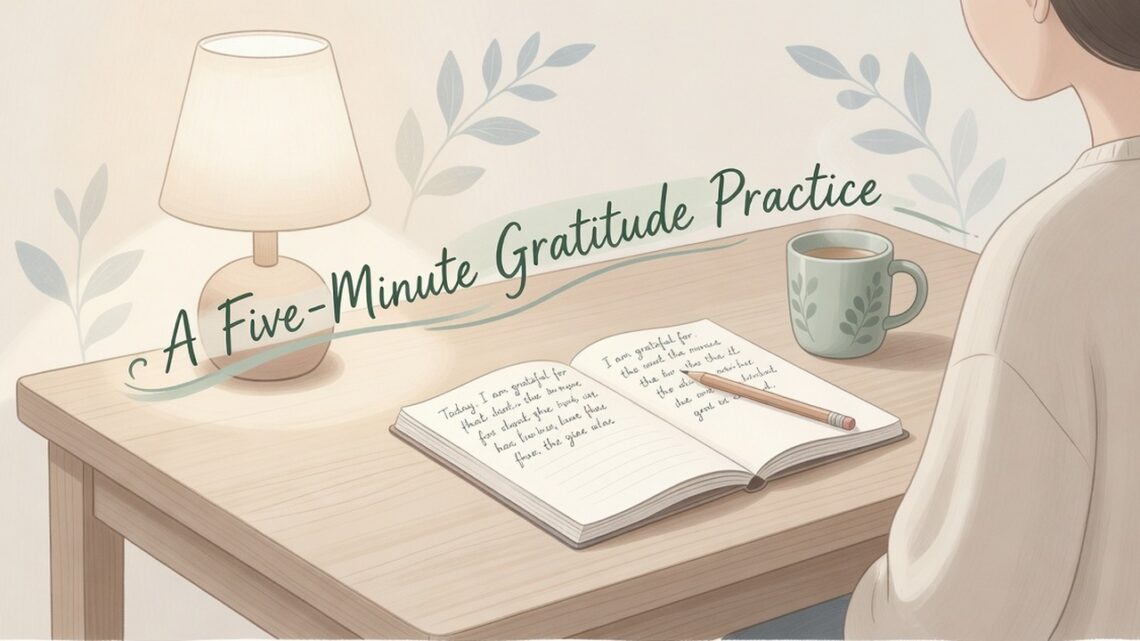
Three things to write in a gratitude journal might look like: a warm drink that helped ease a slow morning, a message that reassured you during a stressful stretch, and a task that finally got done after sitting on your list for days. None of these need to be significant or unusual. Small and ordinary is entirely the point.
No Pen Needed: a Three-Minute Gratitude Practice You Can Do Anywhere
A three-minute gratitude practice works equally well spoken aloud, recorded as a short voice note, or held silently in your mind during a quiet pause. Writing is one option, not a requirement. But if writing feels like friction on a busy day, skip it.
During a commute, you can let your attention settle on three ordinary things you encountered that morning, then add a quiet reason for each one. If you’re walking, keep your phone away. The whole reflection can happen in your head, running alongside your steps. Some people find it easier when they pair the practice with something already in hand: a piece of music they like, or just a warm drink and the simple fact of its warmth.
The NHS Every Mind Matters wellbeing guidance includes noticing and savoring small positive things as one of several everyday approaches to supporting mental wellbeing. The same spirit applies here: gratitude doesn’t require a journal to count as a real practice.
Try This: Pause wherever you are right now. Place both hands around something warm, or simply rest them in your lap. Breathe in slowly for a count of four, then breathe out for a count of four. Bring to mind one specific thing that helped or held steady today. Name it silently, add one brief reason it mattered, then take one more slow breath before returning to what you were doing. That’s the practice, complete.
How to Practice Gratitude When the Day Has Been Hard
On a difficult day, replace “what am I grateful for?” with “what simply worked?” This keeps the practice honest when reaching for appreciation feels hollow or faintly dishonest. The goal isn’t to manufacture a cheerful mood, just to notice what was dependable when things felt heavy.
Three neutral things that functioned might include a safe journey, a meal that was there when you needed it, a temperature comfortable enough to get through the afternoon, or a task you completed even though you didn’t want to. Naming these without fanfare is enough.
Mindful.org notes that a gratitude practice doesn’t require a good mood or a fortunate day. Even a plain acknowledgment of what held steady has value, and that reframing tends to feel more sustainable on hard days than reaching for enthusiasm you don’t genuinely have.
When to Practice Gratitude and How to Build the Habit
The best time for a gratitude practice is whichever time you will use consistently. Morning works well because it sets a quiet, grounded tone before the day gets busy; a lunchtime pause works if mornings are chaotic; bedtime rounds off the day before sleep. None is universally better than the others.
Pairing the practice with something you already do reliably makes it easier to remember: making coffee, sitting down on the train, closing your laptop, or putting your phone on charge at night. It keeps gratitude from becoming another thing you have to remember to do.
Keep the pressure low. Missing a day isn’t a reason to restart from zero or add extra time to compensate. This practice stays worth returning to precisely because it asks so little. If you skip it, pick it up the next day without catching up. Some people also like to send one specific thank-you message a week, naming what the person did and why it helped. It’s a small outward version of the same inward thing.
Quick Takeaways
- Name one to three specific moments and add a short reason each one mattered. That’s the whole practice.
- Concrete details like a helpful reply or a finished task tend to feel more grounding than broad statements.
- Writing is optional. Spoken words, voice notes, and silent reflection all count equally.
- On difficult days, shift the question from “what am I grateful for?” to “what held steady or simply worked?” to keep things honest.
- Linking the routine to something you already do reliably, like morning coffee or closing your laptop, makes it far easier to repeat.
Frequently Asked Questions
- How do you do a three-minute gratitude practice?
- Allow yourself a loose three-minute window and let one to three moments from your day rise naturally to mind. For each one, note what it was and why it felt helpful or welcome. Close with a single unhurried breath. The format is flexible: written, spoken aloud, or silently held in your mind all work equally well, so choose whichever feels least like effort right now.
- Can gratitude be practiced without writing?
- Yes, and many people find that spoken observations, a short voice recording, or a purely mental reflection suit them better than putting pen to paper. Pausing with a warm drink, a piece of music, or a kind message you received and letting appreciation surface naturally is a valid, complete version of the practice. No notebook required.
- What gratitude practice works on a difficult day?
- Try replacing the word “grateful” with “what worked.” Look for three neutral things that functioned: a meal, a completed errand, a moment of physical comfort, or a journey that went smoothly. Honestly acknowledging what held steady on a hard day is more sustainable than reaching for enthusiasm you don’t genuinely feel, and it keeps the practice honest rather than performative.
- How specific should gratitude journaling be?
- Fairly specific tends to work better than very general. Recalling that a friend replied when you felt uncertain is more vivid and easier to sit with than a broad statement like “I am grateful for good friendships.” The concrete detail helps the moment feel real rather than abstract, and that vividness is a good part of what makes the exercise worth repeating.
- When is the best time to practice gratitude?
- The most useful time is whichever fits your actual routine: first thing in the morning, a midday break, or just before sleep. Linking it to something you already do consistently, like making tea or sitting down to lunch, tends to make it easier to keep up than scheduling it as a standalone appointment.
Small, honest, and low-pressure: that’s what keeps it worth coming back to, day after day.
This article shares general wellbeing ideas for educational purposes only and is not medical advice. If you have a health concern, please speak with a qualified healthcare professional.