By Elena Hart · Wellbeing editor
Here is the edited article:Body scan meditation is a structured attention practice in which you move awareness slowly through each region of the body, from head to feet or feet to head, noticing whatever sensation is present without trying to change it. Sessions can run 5 to 45 minutes. No equipment, prior experience, or particular outcome is required.
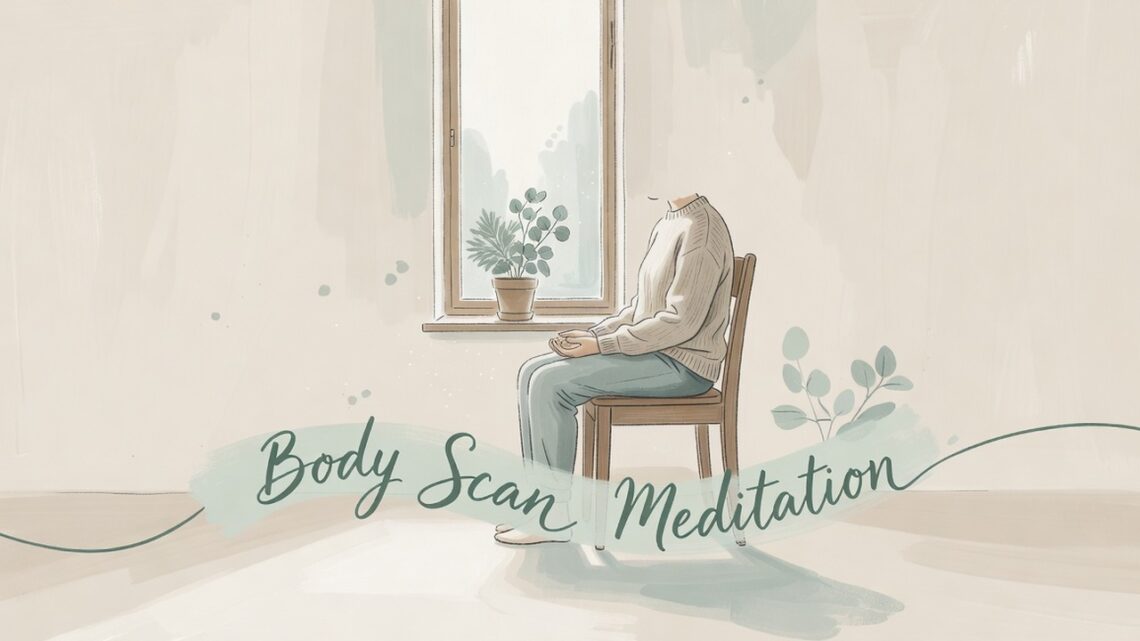
Body scan meditation is a structured attention practice in which you move awareness sequentially through each region of the body, noticing whatever sensation is present without trying to change it. You start at one end of the body, work region by region toward the other end, and stay with each area before moving on.
The practice is most closely associated with Jon Kabat-Zinn’s Mindfulness-Based Stress Reduction (MBSR) program, developed at the University of Massachusetts Medical School in the late 1970s. In the standard 8-week MBSR course, participants practice a 45-minute body scan daily, typically using an audio recording. Shorter sessions of 5 to 20 minutes follow the same basic structure and suit most people starting out on their own.
What distinguishes a body scan from ordinary resting is the active component: you guide attention on purpose, notice when it drifts, and return it. That cycle of noticing and returning is what the practice is built on.
People practice body scan meditation for different reasons: to reduce accumulated physical tension after a demanding day, to quiet mental loops before sleep, and to build clearer awareness of what the body is actually doing. The MBSR program, which introduced this format to clinical settings in the late 1970s, has built a substantial research base around its effects on perceived stress and anxiety.
Free guided audio sessions of varying lengths are available at the UCLA Mindful Awareness Research Center, which publishes recordings suited to different schedules and experience levels.
How to prepare for a body scan meditation session
Body scan meditation requires no special equipment: a comfortable position on a firm surface and a few uninterrupted minutes are all that is needed. Lie down on your back or sit with your back supported. A yoga mat, firm couch, bed, or chair all work. If lying flat tends to pull you toward sleep too early, sitting upright is a practical alternative.
Loose, comfortable clothing helps. Set a gentle timer if you’re working to a specific duration, so you’re not mentally checking the clock. Put your phone on silent or leave it in another room if possible. Dimming the lights or closing curtains helps most people settle faster.
Eyes closed is the most common approach. If closing your eyes invites sleep at the wrong moment, a soft downward gaze at a fixed point a few feet ahead works equally well. Neither is more correct than the other.
The UMass Center for Mindfulness, where MBSR was developed, offers resources for people working through body scan meditation outside a formal program.
How to do a body scan meditation: step-by-step
To do a body scan meditation, settle into your position, take three slow breaths, then move attention through body regions one at a time from feet to head (or head to feet), resting for two to four breaths in each area. Most people begin at the feet and move upward; either direction produces the same result.
For each area, rest your attention there and notice what is present: warmth, pressure, coolness, tingling, tension, or nothing identifiable. Nothing is a valid answer. You’re noticing what’s already there, not generating sensation.
When your mind wanders, return to where you left off and continue from there. That return is the central action of the practice, not something that needs correcting.
A practical sequence for a session of 10 to 20 minutes:
- Feet and ankles
- Lower legs and knees
- Thighs and hips
- Belly, lower back, and chest
- Hands, forearms, and upper arms
- Shoulders and upper back
- Neck, jaw, face, and scalp
When you reach the final area, take a moment to sense the body as a whole before gently opening your eyes. That transition back into the room is part of the practice.
How long should a body scan meditation session be?
A body scan meditation session can run from 5 to 45 minutes. Five minutes is enough for a complete practice when using broad zones rather than individual muscle groups. The 45-minute format used in MBSR is the most thorough, but it’s designed for people practicing daily inside a structured 8-week course, not for independent beginners.
For most beginners, 10 minutes practiced three or four times a week is a practical starting point. That gives you enough repetitions over several weeks to notice how the practice shifts, without a large time commitment up front. Consistency matters more than session length.
Beginning at 45 minutes is not necessary.
One thing that surprises many beginners: a 10-minute session can feel longer than expected when you’re genuinely paying attention. Time perception shifts when you’re not occupied with external tasks.
What body scan meditation feels like when you’re new to it
Most beginners find body scan meditation harder to stay with than it looks: attention drifts constantly toward plans, worries, memories, or random images. This is normal and reflects how untrained attention actually behaves, not a personal failing.
Some areas of the body feel numb or difficult to locate in awareness, particularly regions where people carry chronic tension without being conscious of it. Staying curious rather than trying harder tends to work better. Forcing a sensation rarely produces one; waiting with genuine interest sometimes does.
Outcomes vary: some people feel a notable calm settle in during a scan; others feel restless throughout and notice only a quiet shift in the minutes afterward. Both are valid results of the same practice. The measure of a session is whether you moved attention through the body and kept returning when it wandered, not the feeling it produced on a given day.
The practice generally becomes more accessible after four or five sessions. The sequence grows familiar, the urge to rush settles, and the gaps between mind-wandering extend. Most people notice something shift within the first couple of weeks of consistent practice, though there’s no fixed timeline.
How to use body scan meditation to wind down at the end of the day
A body scan is well suited to end-of-day wind-down because it requires only attention, which remains available even when energy is low. Practiced in bed before sleep, it can help ease you from a high-activity state into something quieter by pulling attention toward physical sensation and away from thought loops.
Body scan meditation is not a sleep technique and does not promise faster or deeper sleep. But many people find that paying attention to physical sensation slows the mental loop, which tends to leave things quieter.
If you fall asleep during a bedtime scan, the practice is complete up to the point where sleep arrived. To stay aware through the full sequence, shift the practice to 20 or 30 minutes before you intend to sleep, or practice sitting upright in a chair rather than lying flat.
A short version of 5 to 8 minutes also fits between transitions during the day: at the end of a workday before switching to an evening activity, or between a commute and arriving home. These shorter sessions don’t require a quiet room or a long time block.
Tonight, once you are lying down, keep the lights off and your eyes closed. Starting at your feet, move attention slowly upward through the body, pausing for two full breaths in each region. Notice what is present without trying to change it. That is a complete body scan meditation, and it takes less time than scrolling before sleep.
- Body scan meditation moves attention through the body region by region, noticing sensation without trying to change it.
- Sessions range from 5 to 45 minutes; 10 minutes is a practical starting length for most beginners.
- The MBSR program, which developed the practice, uses 45-minute daily scans across an 8-week course.
- A wandering mind during a scan is expected; returning attention is the practice itself, not a failure signal.
- Free guided audio sessions are available from the UCLA Mindful Awareness Research Center and the UMass Center for Mindfulness.
Frequently asked questions about body scan meditation
- Do I need a guided recording to practice body scan meditation?
- No guided recording is required to practice body scan meditation. A guided audio helps beginners learn the pacing and keeps attention from drifting for long stretches, making it a useful tool in the early weeks. Once you’ve internalized the sequence of moving through body regions and pausing for several breaths in each area, the practice works equally well in silence.
- What if I fall asleep during a body scan meditation?
- Falling asleep is not a failure, and near bedtime it is quite common. It may simply mean your body was ready to rest. If staying aware through the full scan matters to you, try the practice sitting upright rather than lying down, or shift it earlier in your evening before tiredness fully sets in.
- What are common beginner mistakes in body scan meditation?
- The most frequent mistake is rushing through each area. Other common errors include expecting a specific feeling of calm to arrive on cue and interpreting a busy mind as proof that meditation isn’t working. Slowing down handles most of it. Staying genuinely curious about what each area actually feels like, and not treating a wandering mind as a sign of failure, tends to sort out the rest.
- How often should I practice body scan meditation to notice a difference?
- Three to four sessions a week provides enough repetition to observe how your experience of the practice shifts over time. Daily practice is what the MBSR 8-week program asks for, though shorter or less frequent sessions still build the skill. Consistency over several weeks matters more than hitting a perfect daily streak.
- How do I do a body scan meditation when I only have five minutes?
- Scan through four or five broad zones rather than every individual body part: head and face, neck and shoulders, chest and arms, belly and hips, and legs and feet. Give each zone three or four unhurried breaths. A five-minute version done this way is a complete practice, not a compromise.
This article shares general wellbeing ideas for educational purposes only and is not medical advice. If you have a health concern, please speak with a qualified healthcare professional.