By Elena Hart · Wellbeing editor
TL;DR: Loving-kindness meditation for hard days is a quiet, short practice of repeating gentle phrases of goodwill toward yourself and others. You don’t need to feel warm or peaceful for it to be useful. Even a few minutes of honestly wishing for ease can offer a small, grounding shift when a day feels heavy.
Loving-kindness meditation for hard days asks very little of you. You sit, you breathe, and you repeat a few simple phrases. That’s the whole shape of it. And on the days when everything feels harder than it should, that simplicity is exactly what makes it worth trying.
What Metta Meditation Means
Metta is a Pali word, from the ancient language of early Buddhist texts, that translates roughly as goodwill, benevolence, or loving-kindness. It is one of four qualities known as the Brahmaviharas in Buddhist contemplative tradition, described as qualities of a compassionate and well-lived life. The meditation built around it is straightforward: you sit quietly and repeat phrases that carry the spirit of genuine goodwill.
Metta doesn’t map cleanly onto the English word “love.” It sits closer to friendliness or honest care, the kind that doesn’t depend on how someone behaves or how you happen to feel that morning. That distinction is reassuring. You aren’t being asked to manufacture deep affection or pretend things are fine. You’re simply practicing the gesture of wishing well, as an intention, and that gesture is enough.
Today, metta meditation is practiced across several contemplative traditions. It also shares common ground with compassion-focused therapy, a psychological approach that draws on the science of self-compassion to help people relate to their own difficulties with more warmth and less self-criticism, rather than avoidance or harsh judgment.
The Phrases Used in Loving-Kindness Meditation
Loving-kindness phrases are short, honest wishes. Classic examples include “May I be safe,” “May I be healthy,” “May I be at peace,” and “May I live with ease.” You repeat them slowly, letting each one settle before moving on. The repetition isn’t about convincing yourself of anything. It’s about returning your attention gently to the intention of care.
You don’t have to use the traditional phrasing. On a difficult day, phrases that match where you actually are tend to work better. “May I meet this moment with gentleness” can feel more honest than “May I be happy” when happiness feels a long way off. “May I have enough steadiness for the next few hours” or simply “May I be okay” are both perfectly suitable phrases for a hard afternoon. The American Heart Association offers a beginner-friendly phrase sequence if you’d like a clear starting point.
Once you have a phrase for yourself, you extend the same wishes outward. First to someone you care about, then to a neutral acquaintance, then to a wider circle of people. That outward movement is part of what keeps the practice from feeling self-absorbed. You begin with yourself not because you matter most, but because kindness directed inward is often the hardest part, and it’s a skill worth building slowly.
Try This: Pick one phrase from the examples above, or use “May I be okay right now.” Sit quietly, close your eyes, and repeat it three times at an unhurried pace. Then direct those same words toward one person you care about. Notice any small shift in how your chest or shoulders feel. That is enough for today.
Getting Started With Loving-Kindness Meditation for Hard Days
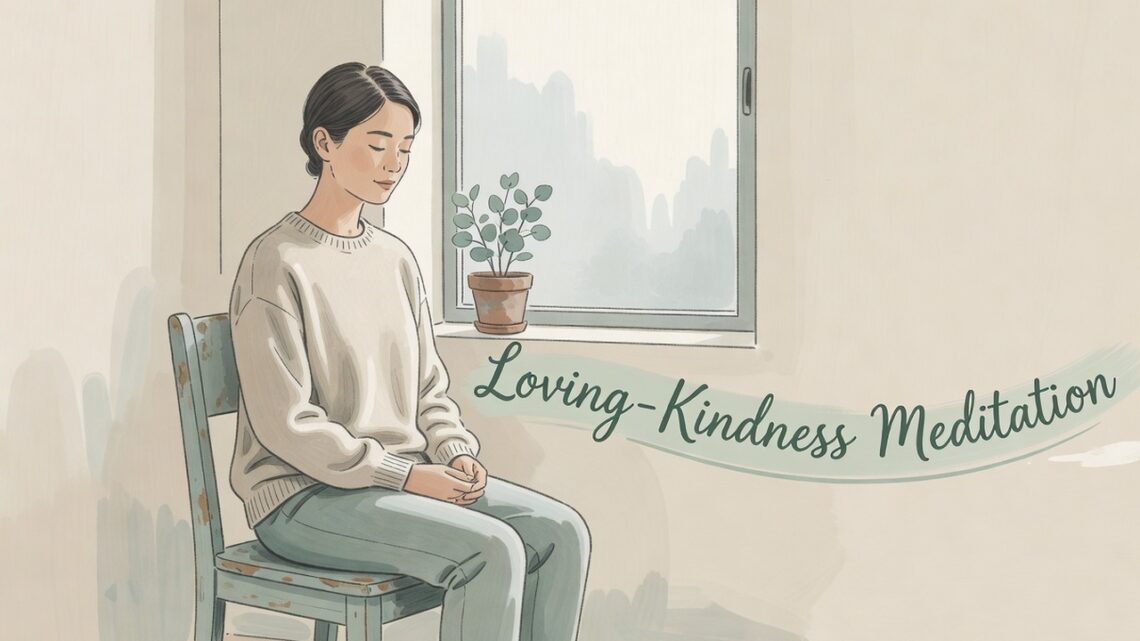
To start loving-kindness meditation for hard days, you need only a chair, a few minutes, and a willingness to try. No cushion, app, or quiet house is required. Settle into a comfortable position. Close your eyes if that feels natural, or soften your gaze toward the floor. Take two or three slow breaths without trying to change anything, just noticing the rhythm of breathing in and out.
Choose one phrase and repeat it quietly in your mind. “May I be safe, supported, and at ease” is a good one to start with. If that feels like too much, try “May I be okay right now.” Repeat the phrase slowly, several times over. When your mind drifts, which it will, gently return to the words. That return is the practice. You aren’t failing when your attention wanders. You succeed every time you come back.
A study published in the Journal of Compassionate Health Care (Springer Nature, 2014) found that sessions of under ten minutes were associated with improved feelings of wellbeing and connection in novice meditators. It’s worth knowing, if you’ve been putting this off thinking you’d need to sit for a long time to feel any difference.
Try This: Wherever you are, rest your hands loosely in your lap and count four natural breaths silently: in and out is one, in and out is two, carry on to four. Keep your breathing as it is; the counting is simply an anchor. When you reach four, let the counting fall away and bring in a single phrase: “May I have enough steadiness for right now.” Repeat it at whatever pace feels unhurried, as many times as feels useful. When you’re ready, return to your day.
Why Loving-Kindness Meditation Works Even When You Don’t Feel Warm
Loving-kindness meditation for hard days does not require you to already feel warm. The practice doesn’t ask you to feel differently than you do. It asks you to direct a gentle intention toward yourself, and that act alone can quietly shift the texture of a difficult hour. A 2023 literature review in the Journal of Evidence-Based Complementary and Alternative Medicine found that loving-kindness meditation may reduce stress and empathic distress and increase positive affect, though the researchers note that evidence varies across studies and practice formats.
The practice also changes how you relate to difficulty rather than erasing it. When you’re struggling, the inner voice often turns harsh: “I should be handling this better,” or “Why can’t I just feel okay?” Repeating a phrase like “May I be kind to myself today” doesn’t silence those thoughts, but it gives you something else to return to. It’s a small interruption in a harsh inner monologue, and over time, those interruptions can become a reliable habit.
You also don’t need to feel especially spiritual or experienced to use this practice. It suits everyday moments: before a difficult conversation, during a short lunch break, or at the end of a long evening. It isn’t a reward for calm days. It’s most useful when things are hard, which is why people often find it more practical than they expected.
How Loving-Kindness Meditation Compares to Mindfulness
Loving-kindness meditation and mindfulness meditation share a common foundation: both ask you to pay attention to the present moment without judging what you find. The difference lies in emphasis. Mindfulness focuses on noticing what is here, your breath, sensations, sounds, thoughts, without trying to alter any of it. Loving-kindness adds an active intention: you repeat phrases that wish yourself and others well. Greater Good in Action at UC Berkeley covers both practices in its freely available wellbeing resource library if you’d like to explore each one in more depth.
Mindfulness meditation tends to be a better fit when you feel scattered and want to return to the present without adding anything extra. It works well as a daily anchor and as a way of observing difficult thoughts without getting swept away by them. Loving-kindness is better suited to moments when your inner voice has turned harsh, when you feel disconnected from yourself or others, or when a day has knocked you sideways and you want something warmer to hold onto.
And the two are easy to combine. Some people begin with a few minutes of mindful breathing to settle, then move into loving-kindness phrases from that steadier place. Neither approach is wrong. The best one is the one you’ll actually use.
When Self-Directed Kindness Feels Uncomfortable
Self-directed kindness is, for many people, the hardest part of loving-kindness meditation. Saying “May I be at peace” can feel self-indulgent, embarrassing, or simply hollow. If that’s your experience, you’re not alone. It often reflects a long habit of extending care to others far more readily than to yourself. The discomfort is useful information: it usually points to exactly the muscle that needs gentle, patient exercise.
One practical workaround is to begin with someone else. Bring to mind a person or animal you love easily, a close friend, a child, a pet. Direct the phrases toward them first. “May you be safe. May you be well.” Let that feeling settle in your chest. Then, when it feels possible, turn the same words toward yourself. Starting from warmth you already have can make that inward turn feel less forced.
If the practice still stirs up uncomfortable feelings, that’s a signal to pause, not push through. Keep sessions short. Use simpler phrases. Or set it aside and return when you’re in a slightly calmer place. If you find that self-compassion practices consistently bring up distressing material, speaking with a counsellor or therapist who can offer proper support is a sensible and worthwhile step.
Try This: Place one hand lightly on your chest. Bring to mind someone or something you care for without effort, a friend, a child, or a pet. Take three slow breaths, holding them gently in mind. Then, keeping your hand where it is, say quietly to yourself: “May I offer myself the same simple kindness.” Breathe through that phrase three more times. You don’t have to feel it fully for it to count.
Quick Takeaways
- Metta, the Pali root of this practice, translates as goodwill or benevolence; honest intention matters more than warm feelings.
- Phrases can be adapted freely. Simpler wishes like “May I be okay right now” are often more useful on difficult days than phrases aimed at happiness.
- Sessions of under ten minutes can still be worthwhile, making this a realistic option for ordinary busy days.
- When turning kindness toward yourself feels awkward, starting with a loved one or pet and then shifting the words inward is a gentle and effective workaround.
- Mindfulness and loving-kindness practices serve different moments; mindfulness suits scattered days, while loving-kindness helps most when self-criticism is running high.
Whenever a day feels heavier than expected, a few quiet minutes with a simple phrase is a small, kind thing to offer yourself. The intention to be gentle with yourself is where the practice lives.
Frequently Asked Questions
- What is metta meditation?
- Metta is a Pali word meaning goodwill or benevolence, and metta meditation is the practice of silently repeating short phrases that carry that spirit of warmth toward yourself and others. It belongs to a family of contemplative qualities called the Brahmaviharas in Buddhist tradition, and today it is practiced widely as an everyday wellbeing habit, entirely separate from any religious context.
- How long should a beginner sit with this practice?
- Five minutes is a perfectly reasonable starting point. Early evidence from the Journal of Compassionate Health Care (Springer Nature, 2014) indicates that even brief sittings, well short of ten minutes, can support a genuine sense of connection and wellbeing in people new to the practice. Keeping early sessions short removes the pressure and makes it far easier to return consistently.
- What are some simple phrases to use when beginning?
- Common starting phrases include “May I be safe,” “May I be healthy,” “May I be at peace,” and “May I live with ease.” These can be adjusted freely to suit where you actually are. Lighter alternatives such as “May I be okay for right now” or “May I meet what comes with a little steadiness” often feel more genuine on difficult or low-energy days than phrases that reach for happiness or joy.
- How does loving-kindness meditation differ from mindfulness meditation?
- Mindfulness meditation involves observing what is present, thoughts, breath, sensations, without judging or trying to alter any of it. Loving-kindness meditation adds an outward intention: you actively wish yourself and others well through quietly repeated phrases. Mindfulness suits moments of scattered attention, while loving-kindness is particularly helpful when the inner voice has turned self-critical or when you want to feel more warmly connected to yourself or the people around you.
- What if self-compassion practice makes me feel uncomfortable or nothing at all?
- Discomfort or a sense of emptiness with self-directed phrases is a common experience and not a sign the practice is wrong for you. Directing kindness toward a friend, family member, or animal you care for easily, then gently extending those same words toward yourself, is a useful way to ease in. If the practice regularly brings up strong distress, pausing and speaking with a qualified counsellor is a sensible and caring step.
This article shares general wellbeing ideas for educational purposes only and is not medical advice. If you have a health concern, please speak with a qualified healthcare professional.