By Elena Hart · Wellbeing editor
TL;DR: The common meditation mistakes beginners make nearly always share one root cause: expecting the mind to go quiet. It won’t, and it doesn’t have to. Short, consistent sessions build the habit faster than long sporadic ones, and each time you notice you’ve drifted and gently return your attention, that moment is the practice working.
- Expecting the mind to go quiet
- Starting with sessions that are too long
- Slumping or forcing an unnaturally rigid posture
- Controlling or forcing the breath instead of observing it
- Applying tight, effortful concentration instead of a light and curious attention
- Falling asleep because of posture or timing
- Labelling a session as bad every time the mind wanders
- Treating meditation as a relaxation technique rather than attentional training
- Meditating only when stressed rather than building a daily practice
- Starting without a habit trigger or a consistent physical space
A Busy Mind During Meditation Is Normal, Not a Sign of Failure
A busy mind during meditation is normal, not a sign of failure. The practice doesn’t ask for silence; it asks you to notice thoughts without following them into the story they’re telling.
When you sit still and stop feeding your brain new stimulation, it carries on doing what it always does: generating thoughts. You simply become aware of a process that was running in the background all along. Jon Kabat-Zinn, who founded the Mindfulness-Based Stress Reduction program, described mindfulness as “paying attention on purpose, in the present moment, non-judgmentally.” That definition says nothing about emptying the mind. The goal is to notice thoughts without getting pulled into them, not to stop them from arising.
The fix is a small shift in framing. Instead of trying to clear your thoughts, treat each thought as a moment of noticing. See it, let it be, return to your breath or body. That act of returning is the core skill you’re building. You’ll do it dozens of times in a single session, and every repetition counts.
Try This: At the start of your next session, give yourself explicit permission to think. When a thought surfaces, say inwardly “thinking” and return to the physical sensation of breath at your nostrils, chest, or belly. Count each return as a point: five returns, ten, twenty. At the end, note the count as your score for that session. More returns simply means more practice repetitions, not a busier or worse mind.
Session Length and Posture: Two Common Meditation Mistakes Beginners Make
Start at Five to Ten Minutes, Not 20 or 30
Start at five to ten minutes, not 20 or 30. Short, regular sessions build the habit far faster than long ones that feel like endurance tests, especially in the first few weeks.
Posture Does Not Require a Cross-Legged Floor Seat
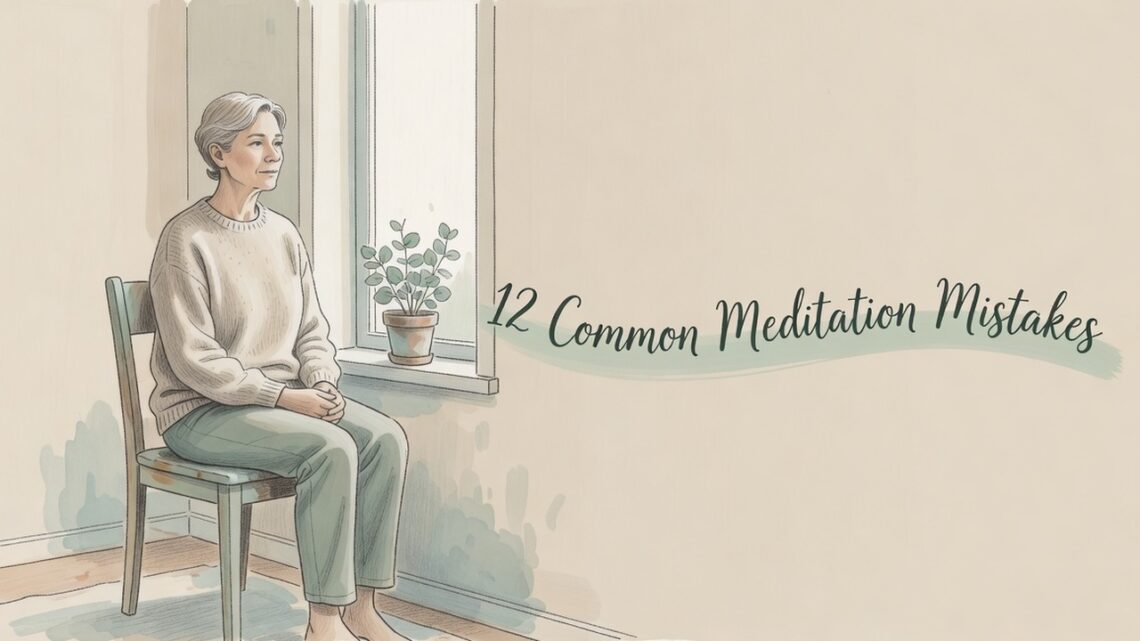
Posture matters more than many beginners realise, but it doesn’t require a cross-legged floor seat. What you need is a position that keeps your back reasonably upright without being rigidly locked, and where you’re comfortable enough to stay still but alert enough not to drift off. A chair with your feet flat on the floor works perfectly well. The common error is slumping: a rounded lower back compresses the diaphragm, reduces alertness, and makes drowsiness far more likely. And forcing an unnaturally straight spine creates muscular tension that keeps pulling your attention away.
A good working rule: sit as if there’s a gentle upward lift from the crown of your head, with your shoulders soft and dropped. Your hands rest in your lap. If sitting is genuinely uncomfortable due to injury or mobility issues, lying flat is a reasonable alternative, though it carries a greater risk of sleep, addressed in a later section.
Try This: Set a five-minute timer and sit upright in any chair, feet flat on the floor, hands resting in your lap. Close your eyes or soften your gaze downward. Notice the physical sensation of breath at your nostrils, chest, or belly. When a thought appears, name it silently as “thinking” and return your focus to that sensation. Repeat until the timer sounds. To turn this into a consistent habit, attach it to something you already do each morning and keep the streak going for seven days before you consider extending the duration.
Breathing During Meditation: A Common Meditation Mistake and Its Gentle Fix
Simply observe your breath as it already is. Do not slow it down, deepen it deliberately, or hold it at the top of an inhale.
Forcing a breathing pattern adds effort and self-consciousness that works against settling. You’re no longer observing; you’re managing. If you notice yourself controlling the breath, ease off and let it find its own rhythm. It may be shallow, it may be uneven, and that’s entirely fine. Your only job is to notice the physical sensation of breathing at whichever point feels most distinct to you.
Many experienced teachers suggest keeping the quality of attention light and curious rather than fixed and tense. Trying to stare at the breath with fierce concentration creates a strained, effortful quality that’s hard to sustain. Think of it as resting your attention on the breath the way you might rest your hand on a table: present, with no grip.
Try This: At your next session, choose one point where the breath feels most distinct: nostrils, chest, or belly. Rest a hand lightly on that area for the first minute so you can feel the movement without steering it. If you catch yourself making the breath bigger or slower, lift the hand, let the rhythm reset on its own, then return your hand and your attention together. After the first minute, place the hand back in your lap and continue with the same quality of attention: present and unhurried, with no grip on the rhythm.
Falling Asleep and Self-Judgment: Two Common Meditation Mistakes Addressed
Falling Asleep Is Fixable With Practical Adjustments
Falling asleep is common and fixable with practical adjustments. Mind wandering is not a problem at all; it’s precisely how the practice works.
If sleep is a regular occurrence, the most useful changes are simple: sit rather than lie down, choose a time earlier in the day, and keep the room slightly cool rather than warm and cosy. Drowsiness is a signal, not a character flaw.
Try This: Before your next session, run a three-point check: choose a firm upright chair rather than a sofa or bed, set the room temperature on the cool side, and pick a time at least two hours after waking. If heaviness still arrives mid-session, open your eyes slightly and let your gaze soften toward the floor rather than closing them fully. Hold that half-open gaze for one or two breaths, then try closing your eyes again once you feel more alert.
Mind Wandering and Returning Is the Exercise, Not a Sign of Failure
Self-judgment is a subtler stumbling block. Many beginners finish a session and label it a “bad meditation” because their mind wandered repeatedly. But wandering and returning is the exercise. Each time you notice you’ve drifted and bring your attention back, that’s a repetition of the very skill you’re building. Calling the whole session a failure because of mind wandering is a bit like going for a walk and deciding it doesn’t count because you had to step around a puddle.
Loving-kindness practice, known in the Pali tradition as metta, can be useful if you’re prone to self-criticism during sessions. The basic form involves silently directing warm, friendly phrases toward yourself and others. Mindful.org’s loving-kindness guide offers a clear, beginner-friendly introduction. It tends to soften the inner critic in a way that breath focus alone sometimes doesn’t, and it places self-compassion within a well-established contemplative tradition rather than treating it as a vague affirmation.
Try This: At the end of your next session, spend two minutes on a simple loving-kindness sequence. Silently repeat three short phrases toward yourself, for example: may I be well, may I be at ease, may I be kind to myself. Then direct the same phrases to someone you care about, then to a neutral person, then to everyone around you. No particular feeling is required. Saying the words with mild, unhurried attention is enough to begin gradually softening a self-critical inner tone over time.
Meditation Is Attentional Training, Not Relaxation
Meditation is attentional training: you notice where your mind has gone and steer it back to a chosen anchor. Relaxation may happen as a by-product, but it’s not the goal and it’s not guaranteed.
That can feel effortful, particularly in the early weeks. Some sessions leave you feeling calm; others feel like herding cats. Both count as practice. This matters because many beginners quit when they don’t feel instantly serene. If you expect meditation to work like a warm bath, you’ll judge each session by how relaxed you feel at the end, and many sessions won’t meet that standard. Treat it as a skill instead, and you start noticing different markers of progress: a quicker moment of recognising you’ve drifted, a bit more ease in returning, a small improvement in patience with yourself over weeks rather than days.
The Greater Good Science Center at UC Berkeley publishes accessible summaries of wellbeing research, including work on attention and mindfulness, that bear this out: the benefits associated with regular practice tend to show up over time and across situations, not necessarily during the session itself.
Try This: After your next session, ask yourself one question: did I notice any moments of returning attention, however brief? If yes, the session was productive regardless of how calm or restless it felt. Jot a single word or short phrase describing the session quality in a small notebook, then set it aside. Over several weeks this log will likely show you that sessions you judged as difficult were still building the skill, and the gap between effort and perceived benefit gradually narrows.
Habit and Consistency: More Common Meditation Mistakes Beginners Make
Meditating Only When Stressed Is One of the Most Common Beginner Mistakes
Meditating only when stressed is one of the most common mistakes beginners make. Daily practice, even just five minutes, builds the skill before a crisis demands it.
Habit Stacking and a Physical Anchor Reduce the Friction That Causes Beginners to Quit
Habit stacking is one of the most practical approaches to consistency. Attach your meditation to something you already do without thinking: right after your morning coffee, before you brush your teeth at night, or at the end of your lunch break. The existing habit provides the trigger. Without a reliable cue, the practice stays optional, and optional usually means skipped on busy days.
A physical anchor also helps: a specific chair, a cushion, even a candle you light before you sit. These small environmental cues lower the friction that derails beginners most often. The MBSR program at UMass has long emphasised informal daily practice alongside formal sitting, recognising that short, frequent repetition outweighs occasional long efforts when it comes to building a durable habit.
Try This: Choose one existing daily habit, such as making your morning coffee or finishing your lunch break, and commit to your five-minute session immediately after it every day for seven days. The night before, place your cushion, chosen chair, or a small visual cue somewhere you will see it at that moment. Treat the seven days as a fixed trial: no adjusting the duration until the streak is complete, then reassess.
Starting a meditation practice doesn’t require perfect conditions or a particular temperament. Pick a small window of time, an ordinary chair, and begin again tomorrow, knowing that even a handful of returning moments in a session counts as genuine, worthwhile practice.
Quick Takeaways
- A busy mind during meditation is normal and expected; noticing thoughts without chasing them is the actual skill you’re developing.
- Five minutes practiced daily builds a far stronger foundation than a 30-minute session once a week.
- Let your breath follow its natural rhythm rather than forcing it; a light, curious quality of attention works better than tight concentration.
- Linking practice to an existing daily cue, and setting up a consistent physical space, dramatically reduces the friction that causes beginners to quit.
Frequently Asked Questions
- What is the difference between meditation and relaxation?
- Meditation is a form of attentional training in which you practise noticing where your mind has wandered and returning it to a chosen anchor. Relaxation is a physical and mental state that sometimes arises as a by-product of that training, but it’s not the aim. Some sessions feel effortful rather than restful, and that is a normal and productive part of building the skill.
- How long should a complete beginner meditate each day?
- Starting at five minutes is a sensible and widely recommended entry point. A brief daily session creates a consistent routine far more reliably than attempting longer sits that feel daunting. Once five minutes feels comfortable and you’re doing it without negotiating with yourself, adding two or three minutes every couple of weeks is a reasonable progression.
- Is it normal to fall asleep during meditation, and what can help?
- Falling asleep during practice is a common experience, especially for people who are tired or who sit in a very reclined position. Choosing an upright chair, selecting a time of day when you’re not at your drowsiest, and keeping the room on the cooler side are practical adjustments that support alertness during a session without requiring any particular technique.
- Do I have to sit cross-legged on the floor to meditate properly?
- No. The practical requirement is a posture that keeps you upright and reasonably alert, not any specific position. Sitting on a chair with both feet flat on the floor is a fully valid option used regularly by experienced meditators and teachers. What to avoid is slumping, which dulls alertness, and an artificially rigid, locked-straight spine, which creates distracting muscular tension.
- How do I work with self-criticism when I keep losing focus during a session?
- Reframe what losing focus means: noticing you’ve drifted and choosing to return is the core action of the practice, not a sign that the session has gone wrong. If self-critical commentary feels persistent, a short loving-kindness session, in which you silently direct simple phrases of goodwill toward yourself, can gradually soften that inner tone and make practice feel less like a performance to be judged.
This article shares general wellbeing ideas for educational purposes only and is not medical advice. If you have a health concern, please speak with a qualified healthcare professional.