By Elena Hart · Wellbeing editor
TL;DR: The simplest form of meditation is mindful breathing: sit or stand comfortably, notice your natural breath, and gently bring your attention back each time it wanders. No equipment, no special posture, and no prior experience needed. Even a single minute of paying attention this way can leave you feeling a little more grounded.
Why the Simplest Form of Meditation Is Mindful Breathing
The simplest form of meditation is mindful breathing because the breath is always present, requires no equipment, and demands no prior training. You place your attention on the natural movement of air coming in and going out, and you notice when it drifts away.
As described in Mayo Clinic’s mindfulness guide, mindfulness means paying attention to the present moment without judging what you find there. The breath is a natural anchor for that: it’s happening right now, and it asks nothing of you except noticing.
And that ease matters more than it might seem at first. When a practice is simple to begin, you’re more likely to actually begin it. One slow breath taken with full attention is a real and complete act of meditation, not a lesser version of one.
How to Practice the Simplest Form of Meditation: Three Steps
Breath meditation has three parts: notice the breath, observe when attention wanders, and return without criticism. You repeat those steps for however long you have. No step matters more than the others.
Many people expect meditation to feel peaceful or profound from the start. It rarely does. What you’ll mostly notice is that your mind moves around a great deal. That’s fine, and it’s exactly why the return matters. Each time you redirect your attention back to the breath, you’re practicing the central skill.
Try This: Set a timer for two minutes. Sit or stand comfortably, feet flat, hands resting easily. Feel the weight of your body. Breathe in through your nose and let it out slowly, counting this exhale silently as “one.” Continue up to five, then restart at one. When a thought pulls you away, note silently “wandered” and return to your count. When the timer sounds, take one final slow breath before continuing with your day.
Counting breaths is a form of focused attention meditation, a category that asks you to hold awareness on a single point and return there whenever attention slips. The count gives your mind a small, friendly task so there’s always somewhere specific to come back to.
What Beginners Should Focus On: Physical Sensations of Breath
Beginners should focus on the physical sensations of breathing: the slight coolness at the nostrils on an inhale, the gentle rise of the chest or belly, and the brief natural pause between one exhale and the next breath beginning. The answer to “what am I noticing?” is simpler than most people expect.
You don’t need to control the breath or slow it down deliberately. You’re observing what your body already does, not directing it. That distinction matters because trying to breathe perfectly can become its own quiet source of tension, which is the opposite of what you’re after.
If focusing on the breath feels uncomfortable for any reason, you can shift your anchor. The Cleveland Clinic notes that meditation takes many accessible forms and that brief breath awareness can help you feel more grounded in the present. Nearby sounds work as anchors too: simply listen without labeling them good or bad, then return to listening when your mind wanders. The breath is just the most available option for most people in most moments.
Try This: Sit or stand comfortably and close your eyes. For two minutes, let your attention rest on whatever sounds are present around you. Notice each sound as it arrives without judging it pleasant or unpleasant. When your attention moves toward a thought, notice the shift, then return to listening. No particular sound needs to be present; you are simply noticing what is already there. When the two minutes end, take one full breath before continuing with your day.
What to Do When Your Mind Wanders During Meditation
Your mind will wander during meditation, almost certainly within the first thirty seconds. This isn’t a failure and it isn’t a sign that you’re bad at meditating. A wandering mind is the standard starting condition for everyone who has ever sat down to practice, regardless of how much experience they have.
Noticing that your attention has drifted is itself a moment of awareness. PositivePsychology.com frames meditation as the practice of intentional, one-pointed attention and describes the return of a wandering mind as the central skill being developed, not an interruption of the practice. Each return is the exercise, the same way a repeated movement at the gym is the exercise rather than the resting position between repetitions.
What doesn’t help is responding to distraction with frustration or self-criticism. The thought “I’m terrible at this” is simply another thought, like any other. Notice it, let it settle, and come back to the breath. Over time, the gap between noticing that you’ve drifted and finding your way back tends to shorten on its own.
Any Posture Works for the Simplest Form of Meditation
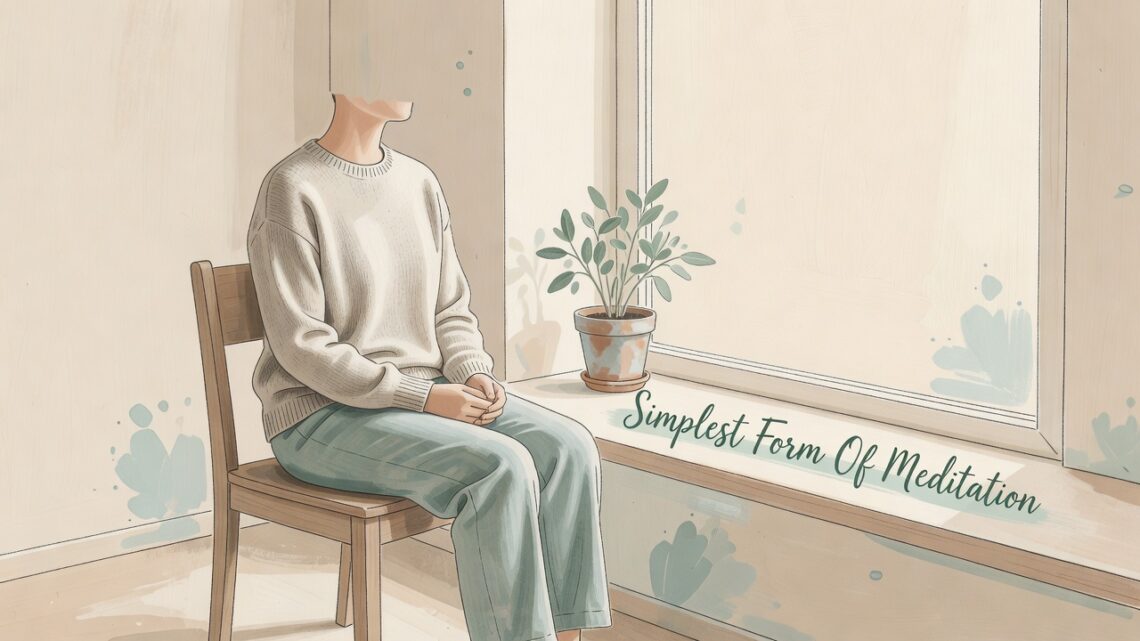
No special posture is required for mindful breathing meditation. You can meditate seated in an ordinary chair, standing at a window, perched on a low wall, or lying on your back before sleep. A cross-legged floor cushion is one valid option among many, not a requirement.
What matters is that your body is comfortable enough to stay still and alert enough not to drift into sleep. If you’re sitting, an upright but relaxed spine tends to help you stay present. Your eyes can be closed, fully open, or softly lowered toward the floor. None of these choices changes what the practice fundamentally asks of you.
The same freedom applies to setting and timing. A quiet room can help, especially when you’re new to this, but many people practice on trains, in parked cars, or at their desks. A consistent time, maybe just after waking or during a lunch break, can help the habit take root. Neither a teacher nor an app is required, though a short guided audio can offer useful structure if starting from scratch feels daunting.
How to Carry Mindful Breathing Into Everyday Life
Breath awareness extends naturally beyond formal sitting sessions into almost any brief pause in your day. The moment before you open an email, the thirty seconds while a kettle boils, the walk between one room and another: each is long enough for a few attentive breaths.
Walking meditation takes this a step further. You slow your pace, feel each foot make full contact with the ground, and keep the breath in soft awareness alongside that movement. It suits people who find sitting still difficult and can be folded into an existing daily walk without adding extra time. The practice is rooted in contemplative traditions and pairs present-moment attention with simple, repetitive movement.
Try This: On your next short walk, slow your pace by about half. Feel your heel contact the ground first, then your midfoot, then your toes pressing off. Count four slow steps on the inhale and four on the exhale. When your mind moves toward a thought, notice it, bring your attention back to foot contact, and pick up the count from where you left off. Any distance works. Even two minutes of this applies the same return-the-mind skill to movement.
That’s where mindful breathing becomes most useful as a daily habit: it asks nothing extra of your schedule. You’re already breathing. You’re already moving through your day. The practice is simply a matter of pausing to notice what’s already there, and returning to that noticing whenever you remember.
Whatever your starting point, one breath taken with full attention is a genuine beginning. The habit tends to deepen with each small return.
Quick Takeaways
- Breath meditation is available right now, wherever you are, with nothing to prepare and no experience required.
- The central skill is returning attention to the breath, not achieving a blank or perfectly quiet mind.
- A mind that wanders is working as expected; each deliberate return is what you’re actually building.
- Any comfortable, alert posture works, and even a single minute of genuine attention is a complete practice.
Frequently Asked Questions
- Is mindful breathing really the easiest meditation for beginners?
- For most beginners, breath-focused practice is the most accessible entry point because the anchor is always present and nothing needs to be purchased or set up. It can be done in very short sessions, and the core skill it develops, redirecting a wandering mind, carries over naturally into any other style of meditation a person might want to explore later on.
- Can you really meditate for just one minute?
- One minute of deliberate breath awareness is a complete practice in its own right, not a shortcut version of something longer. For many people, a brief daily pause is far easier to sustain over time than a lengthy commitment, and showing up consistently tends to matter more than the duration of any individual session.
- What is the difference between mindfulness and meditation?
- Meditation is a formal practice during which you deliberately direct your attention, usually on the breath, for a chosen period. Mindfulness is the broader quality of present-moment awareness that meditation helps strengthen. You can carry mindful attention into any activity throughout the day, while meditation is the dedicated time you set aside to train and reinforce that quality.
- Do you need to sit cross-legged on the floor to meditate properly?
- No traditional posture is required. What matters is finding a position that’s comfortable enough to remain still without strain, and alert enough that attention doesn’t drift toward sleep. Most people use a chair. Sitting on the floor, standing, or lying down each have their practical uses depending on the time of day and your situation.
- Can you meditate while walking?
- Walking meditation is a recognized practice with deep roots in contemplative traditions. The method pairs attentive awareness of physical movement, particularly foot placement and body rhythm, with gentle breath awareness. It’s especially well suited to people who find seated stillness uncomfortable, and it can be folded into an existing daily walk without requiring any additional time.
This article shares general wellbeing ideas for educational purposes only and is not medical advice. If you have a health concern, please speak with a qualified healthcare professional.