By Elena Hart · Wellbeing editor
TL;DR: How to take a real break, not just scroll, comes down to a few honest swaps: put the phone out of reach, give your break a specific offline anchor, and protect a handful of daily moments from automatic checking. Small changes build on each other without requiring a complete overhaul.
How to take a real break, not just scroll, starts with noticing one automatic motion: reaching for the phone before quite deciding to. Sit down, pick up the phone, open an app. A few minutes later you feel neither refreshed nor particularly informed. That cycle is worth interrupting, and you don’t have to delete every app to do it.
How to Take a Real Break: What Separates Rest From Screen Time
A real break gives your nervous system a chance to shift gears by stepping away from reactive, fast-moving information. Scrolling a feed doesn’t offer that shift: each swipe introduces something new that requires a small mental response, keeping your system alert rather than resting. That shift happens when your attention settles on something slower, like a view out the window, a cup of tea, or a few minutes of walking.
The difference between rest and screen time isn’t about the phone itself. You can use a phone restfully by listening to calm music, reading an e-book, or following a breathing exercise. The issue is content that demands quick emotional reactions, such as news headlines, social comparison, or heated comment threads. That kind of input keeps the stress response ticking quietly along, even when you think you’re relaxing.
A simple test: if you feel more tense after 10 minutes of it than before, it’s not a break. A real break leaves you at least a little calmer than when you started. Checking against that measure over time helps you notice which habits restore energy and which drain it.
Why Scrolling Blocks a Real Break (and Leaves You More Tired)
Scrolling keeps triggering small mental responses one after another, which is why 20 minutes of it can leave you more fatigued than rested. Social feeds and news apps are built around this: every new piece of content asks a small question, is this important, do I feel good or bad about it, should I act? That low-grade decision stream tires you out even when nothing dramatic is happening.
Doomscrolling, the habit of moving through distressing news or social content for extended stretches, amplifies that fatigue. The content triggers mild anxiety, outrage, or sadness in rapid succession. But your body doesn’t fully distinguish between small stressors and large ones; it responds to each with a small activation. Over an hour, those activations add up quietly.
Phone use before sleep adds another layer because bright screens signal to your body that it’s still daytime. The Cleveland Clinic notes that heavy phone use, particularly around social media, is linked to poorer sleep and higher stress. That light signal works against the body’s natural rhythms, making it harder to feel sleepy when you want to.
How to Take a Real Break, Not Just Scroll: The Best Moments in Your Day
Morning, mealtimes, and the 10 minutes before bed are natural hinges where taking a real break is easiest to build in. They already involve a pause, which makes them easy places to go phone-free.
Protecting the morning from phone use is one of the easiest places to start. Checking the phone as soon as you wake up loads your mind with other people’s priorities before you’ve had a moment of your own. Keeping the phone off for the first 15 minutes while you make coffee or sit quietly can make the morning feel less reactive. A physical alarm clock placed in the kitchen helps, because it removes the excuse to have the phone beside the bed at all.
Mealtimes are another natural opening for a phone-free break. Eating while scrolling splits attention in a way that makes both the food and the content feel less satisfying. A screen-free meal, even a short one, gives you a natural pause: put the phone face-down or in another room, eat, and notice how the food tastes. The University of Florida IFAS Extension includes scheduled phone-free mealtimes among its practical starting points for families reducing screen habits.
How to Take a Real Break: Setting Up Phone-Free Time That Holds
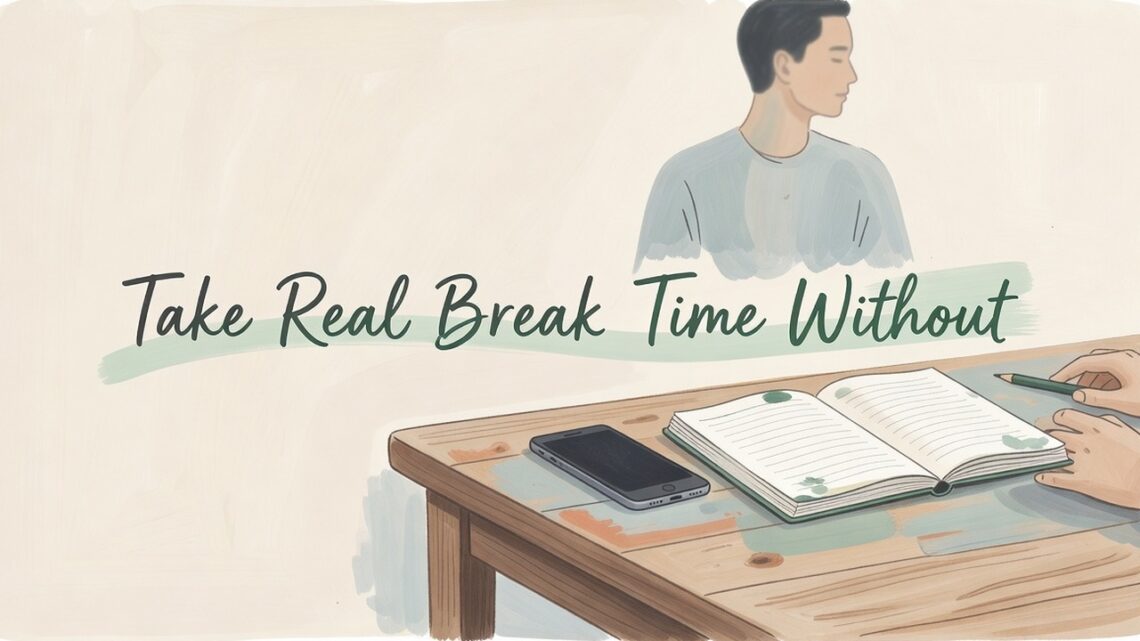
Moving the phone out of arm’s reach before the break starts is the most effective single change you can make. When the phone is visible, the urge to check it stays active even if you don’t act on it. Putting it in a drawer, a bag, or another room removes the low-grade tug so you can actually settle into the pause.
Notifications play a large role in whether phone-free time actually holds. Most people receive a stream of alerts that aren’t urgent: social likes, promotional emails, app updates, news tickers. Each one is a small invitation back to the screen. Turning off non-essential notifications means your phone is quieter during off-screen time, and any check-in you do make becomes intentional rather than reactive. Most phone settings let you keep calls and messages from specific people while silencing everything else, which is a workable middle ground.
Setting 2 to 3 specific check-in windows during the day reframes scrolling as a deliberate choice rather than a background habit. Rather than promising to stop scrolling entirely, you schedule intentional slots when you do open apps and news. Outside those windows, the expectation is simply that you don’t. That makes the phone easier to put down between those windows.
Try This: The next time you feel the urge to scroll, pause for 5 seconds and ask yourself one question: what do I actually want right now, rest, distraction, connection, or information? Then choose an activity that genuinely matches the answer. You may still pick up the phone, but you’ll be choosing rather than reaching on autopilot.
Simple Offline Activities to Take a Real Break From Scrolling
Hand-based activities and short walks are the most reliable offline swaps because they satisfy the same restless energy that reaches for the phone. The break needs somewhere to land, and it doesn’t need to be impressive: reading a few pages, making tea, or stepping outside for a moment all work without any preparation.
Knitting, sketching, cooking, or even folding laundry gives your hands something to do while your mind drifts in an easier direction. Walking without the phone is another reliable swap. Even a short loop around the block, without earbuds if you can manage it, offers a sensory reset that a feed never can. Mental Health First Aid notes that stepping away from social feeds regularly is one of the more straightforward things people can do to reduce digital fatigue.
Starting with one swap works better than trying to overhaul everything at once. Pick a single moment, such as the first 5 minutes after lunch, and spend it offline for one week. A small habit that holds is more useful than an ambitious one that falls apart by day three. And once the first swap feels natural, adding a second one becomes much easier.
How to Take a Real Break, Not Just Scroll, Before Bed
Charging the phone outside the bedroom is the simplest bedtime change, and it removes the temptation at both ends: when you wake and just before sleep. Scrolling close to sleep keeps your mind engaged at exactly the moment it needs to wind down. Content that triggers emotion, whether funny, sad, or outrage-inducing, is particularly disruptive because it keeps the nervous system running when you need the opposite.
A short wind-down habit in the phone’s place gives the brain a gentler signal that the day is over. Something as simple as reading for 10 minutes, writing 3 sentences in a notebook, or doing a brief body scan all work. The UW Medicine health library explains how light from screens in the evening can interfere with the body’s natural wind-down signals, and recommends reducing screen use in the hour before bed as a practical step.
Cleaning up your feeds can also make a difference. Unfollowing or muting accounts that consistently leave you feeling worse takes only a few minutes and changes the quality of any screen time you do keep. A calmer feed makes the moments when you do scroll feel less draining, and makes the choice to put the phone down a little easier.
The question of how to take a real break, not just scroll, doesn’t need a dramatic answer. One small change at a time, practiced in the moments you already have, is enough to shift the pattern quietly.
Quick Takeaways: Taking a Real Break
- A real break reduces mental activation; scrolling tends to sustain it.
- Moving the phone out of sight is one of the most effective single changes you can make.
- Turn off non-essential notifications so off-screen time isn’t constantly interrupted.
- Replace scrolling with a specific offline activity rather than simply trying to stop.
- Protect 3 natural hinges in your day: morning, mealtimes, and the window before bed.
- Start with one change and let it settle before adding another.
Frequently Asked Questions: How to Take a Real Break
- What is the difference between a real break and passive scrolling?
- A real break lets your attention settle on something slower and less reactive, like a walk, a few pages of a book, or a quiet meal. Passive scrolling keeps feeding the mind new stimuli that each require a small emotional response, keeping you alert rather than rested. A useful test: notice how you feel 10 minutes in. More settled means it’s a genuine break.
- How do I take a phone-free break when I feel like I cannot switch off?
- Start by making it a physical change rather than a mental one. Put the phone in another room or a bag before the break starts, so the decision is already made. Pair the break with a specific activity, even something as simple as making tea or stepping outside for 5 minutes, so your attention has somewhere to land instead of defaulting back to the screen.
- How do notifications affect my ability to rest during a break?
- Every notification re-engages your attention with the phone, even if you don’t act on it, because it signals that something may need a response. Turning off non-essential alerts, like social updates and promotional emails, reduces how often the screen pulls you back. Selective alert settings on most phones let you preserve calls and priority contacts while muting the rest.
- What role do bedtime screen habits play in feeling refreshed?
- Scrolling close to sleep keeps your mind engaged when it needs to wind down, and screen light can interfere with your body’s natural sleepiness signals. Charging the phone outside the bedroom and swapping the scroll habit for something quieter, like reading or writing a few lines, gives your brain a clearer signal that the day is done.
- What are the easiest offline activities to swap in during a no-scroll break?
- Activities that occupy your hands and move at a slower pace work well because they satisfy the same restless energy that reaches for the phone. Reading a few pages, taking a short walk without earbuds, doodling, doing a simple puzzle, or cooking something straightforward all require no setup. They tend to leave you feeling more rested than the same amount of scrolling would have.
This article shares general wellbeing ideas for educational purposes only and is not medical advice. If you have a health concern, please speak with a qualified healthcare professional.